

FMUSER Customized Hotel IPTV Solution for Cruise Ships and Airplanes
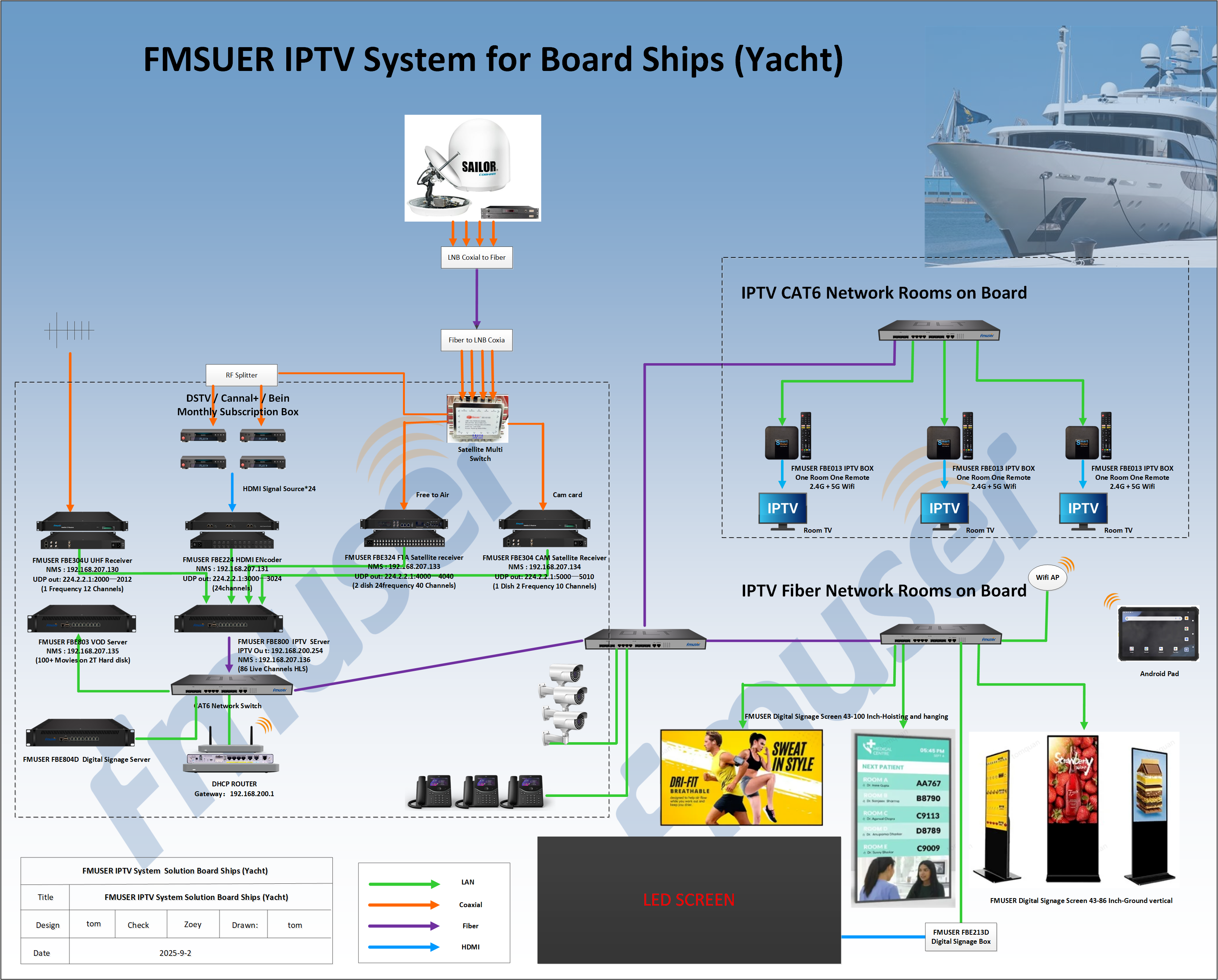
FMUSER Yacht IPTV Solution Topology: This schematic details the complete hardware architecture, from satellite content acquisition and FBE series headend processing to the final dual-path distribution via CAT6 and fiber networks.
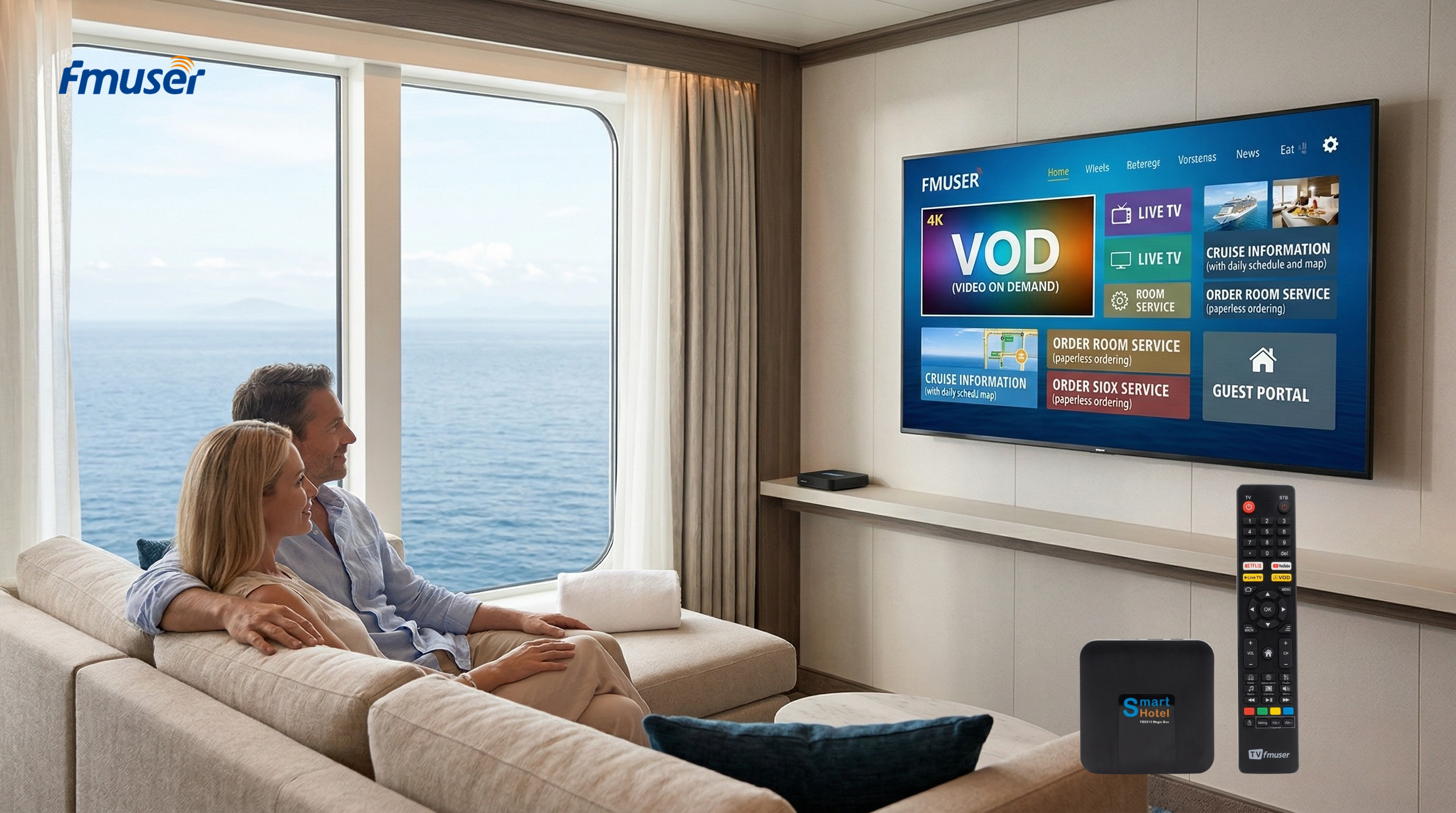
FMUSER Interactive Guest Experience: A couple relaxes in their luxury cruise cabin, utilizing the customized FMUSER IPTV portal for 4K VOD, cruise info, and paperless room service.

FMUSER IPTV Quick Connection Guide: This schematic provides a clear visual blueprint of the core system wiring, differentiating the critical management, internet, and IPTV data signal paths required for proper deployment.

The FMUSER FBE013 smart hotel IPTV set-top box is supplied with the FBE 015 PLUS custom remote control and essential cabling, ready for immediate guest room installation.
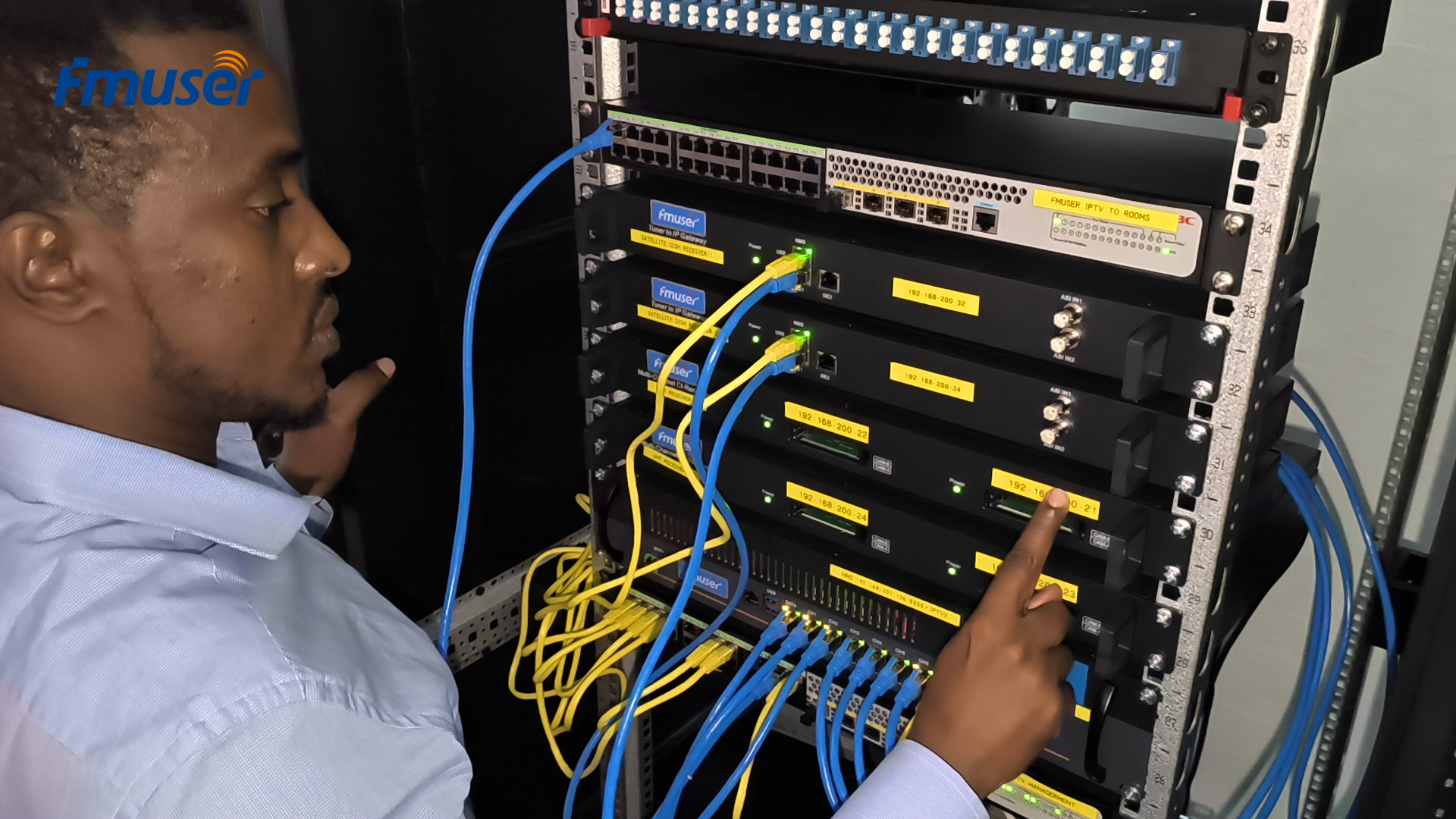
FMUSER FBE800 IPTV servers and equipment neatly installed in the hotel's server room, utilizing existing CAT6 cabling.
FMUSER's custom hotel IPTV solution for cruise ships and airplanes replaces coaxial TV, offering stable, internet-free VOD and interactive guest services.
GUANGZHOU, CHINA, March 30, 2026 /EINPresswire.com/ -- To address the growing demand for stable onboard entertainment across global commercial routes, including the Middle East and Africa, the Guangzhou company FMUSER has detailed its specialized hotel IPTV solution. Engineered for the physical constraints of cruise ships and commercial airlines, the system provides passengers and crew with high-quality media access without relying on continuous internet connectivity.Traditional coaxial television setups on mobile vessels and aircraft face documented limitations: restricted analog channel capacity, severe signal degradation from marine weather or high altitudes, and a complete lack of two-way interactivity. To bypass these hardware limits, engineers modified a standard hotel iptv system to deliver live multicast traffic and large Video on Demand (VOD) files over local Ethernet networks.
Overcoming Physical Space and Network Constraints
Deploying network video in mobile environments requires managing tight rack spaces and unstable external uplinks. To maintain signal stability, the system utilizes marine satellite tracking antennas combined with robust internal networking. Crucially, the system includes an automated fallback mechanism designed for harsh environments; when the channel signal is interrupted, the system automatically and seamlessly switches to a locally looping video library. This automated redundancy completely prevents the black screen phenomenon during satellite dropouts.
Instead of bulky coaxial matrices, the local headend setup is physically compact, occupying fewer RU spaces in the main distribution frame. The architecture relies on the FBE801 IPTV gateway, which acts as the central server to route IP packets, store massive VOD files on local drives, organize live channels, and manage individual user profiles.
At the endpoint, FBE013 Magic STBs are mounted directly behind cabin screens or aircraft seatback displays to output high-definition video. To operate under constant physical vibration and extreme environments, the hardware utilizes shielded high-quality cabling, secure mounting brackets, and industrial connectors. This multicast network operates entirely offline, pushing video directly from the local server to endpoints even in zero-connectivity zones.
Media Management and Passenger Privacy
Serving a diverse passenger base requires extensive media options and flexible access controls, functioning similarly to premium hospitality iptv solutions. The system distributes a broad range of international and local live channels, alongside a rich VOD library. Furthermore, hardware encoders are integrated to take raw HDMI feeds from onboard cameras, live event broadcasts, or promotional videos and convert them into standard IP streams.
Beyond standard broadcasts, the system allows users to cast content using their personal Netflix or YouTube accounts. To address the data security concerns of high-end travelers, the platform features a privacy protection function where guests can clear their connected account information with one click when checking out or making an active choice, preventing any privacy leaks.
The Passenger Portal: Specialized Travel Services
Modern onboard IP video networks function as a central hub for all HTTP requests and ship/aircraft data. It integrates seamlessly with internal services, mirroring a smart hotel TV system.
Interactive Services: Passengers can access room service and book shore excursions. A key feature is paperless dining, allowing guests to order meals directly through their cabin or seat screen.
Targeted Travel Information: The system displays real-time flight information for over 3,000 airports worldwide. Additionally, the system is configured specifically for Middle Eastern and Muslim clients to display accurate prayer times.
Announcements and Safety: The gateway routes digital signage data to dynamic displays across the vessel. For emergency protocols, the system integrates with the onboard PAGA system, forcefully overriding audio and prioritizing emergency video distribution to all screens.
System Scaling and Future Maintenance
Migrating to packet-based video represents a strategic infrastructure upgrade, matching the operational efficiency of standard iptv solutions for hotels. The LAN infrastructure is designed to scale for any platform size, utilizing specific IGMP snooping configurations for larger networks. Hardware maintenance and future firmware updates are conducted locally, ensuring the onboard entertainment system remains operational and up-to-date for years.
Tom Lee
FMUSER
+86 139 2270 2227
sales@fmuser.com
Visit us on social media:
LinkedIn
Facebook
YouTube
Legal Disclaimer:
EIN Presswire provides this news content "as is" without warranty of any kind. We do not accept any responsibility or liability for the accuracy, content, images, videos, licenses, completeness, legality, or reliability of the information contained in this article. If you have any complaints or copyright issues related to this article, kindly contact the author above.
